Showing posts with label State of the Art. Show all posts

Thursday, January 24, 2019

New Year, New Data: Additions to the Passes and Patterns Knowledge Base

1. Abstract

    An update on the developments affecting the various articles previously published in this space, covering both the analyses of other work and original research. Datasets for original research have been updated with 2018 data for both the CFL and U Sports. Previously written state of the art pieces that have seen new work in the field include a postscript to the original work to fold in the new research. Finally, original research previously done has been updated with the new data brought in.
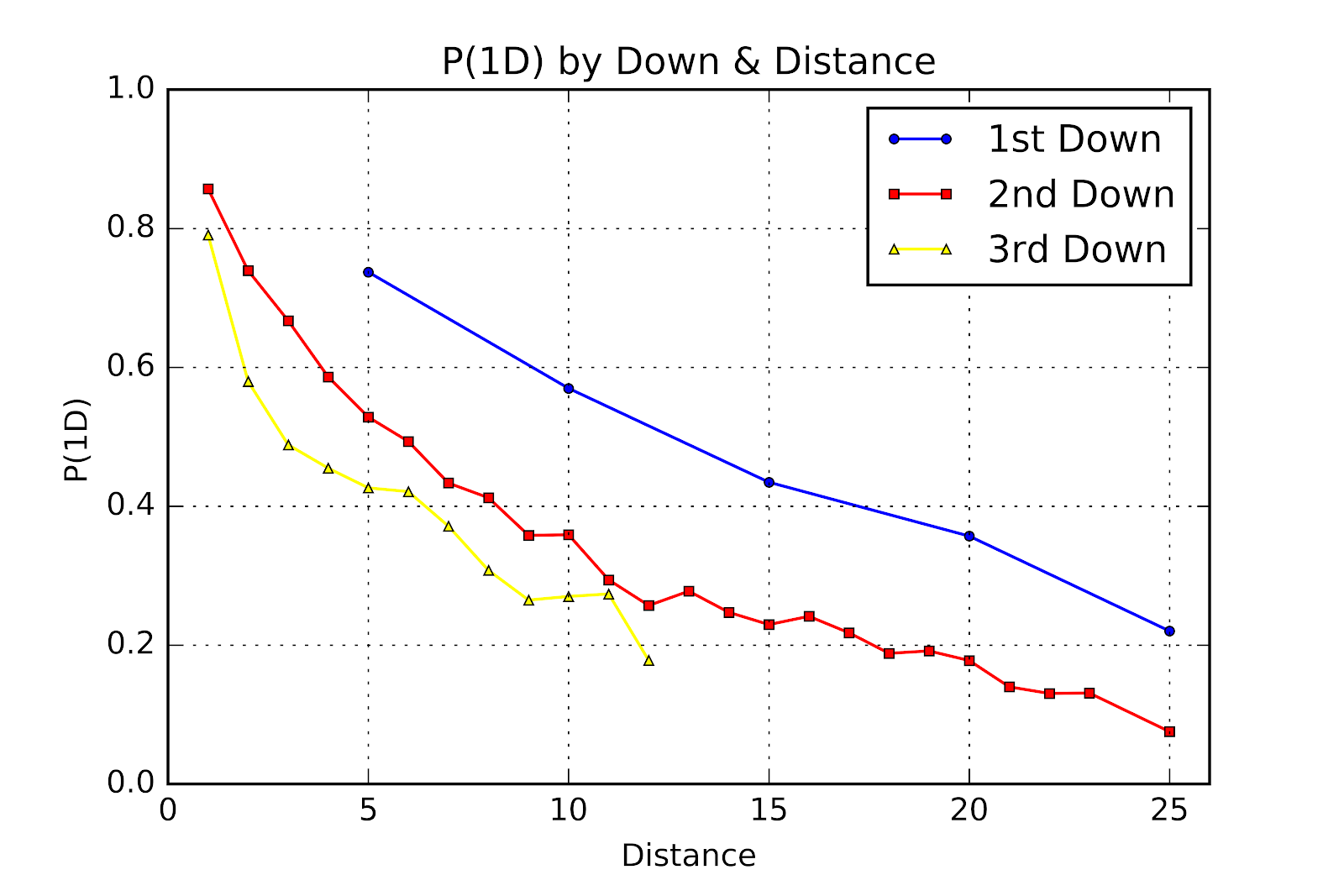
    The critical developments covered here include an American P(1D) (Pelechrinis and Papalexakis 2016b) model that shows non-linearity for 3rd down in a manner similar to that previously found in Canadian football (Clement 2018e, [g] 2018), and the development of a WP model for Canadian football (Thiel 2019).

    Monday, January 7, 2019

    Given the Boot: The Analytics of Kickoffs

    1. Abstract

    The third piece in a series on the current state of affairs regarding analytical research into football’s kicking plays, this piece looks at kickoffs. The broad conclusions to draw from the corpus are that the rule changes regarding touchbacks have had a major impact in reducing the number of kickoff returns and negatively impacting the starting field position after a kickoff; and that onside kicks are underutilized. Their success rate is almost entirely dependent on whether or not the kicking team is obliged by game situation to attempt an onside kick, and non-necessary onside kicks have a far higher success rate, high enough that their use is currently an under-exploited area of opportunity.

    Monday, December 17, 2018

    Three Point Plays: The Analytics of Field Goals

    1. Abstract

    A look at the development of models determining field goal probability, and related studies of meaningful predictor variables. Logistic regression is the most common way of incorporating different predictor values, with a single example of a neural network. Distance is unfailingly the strongest predictor of success, and by an order of magnitude over any other variable. Useful environmental variables also include wind, rain, and altitude. The question of clutch kicking is discussed ad nauseum, with a general consensus of there being little effect if any, and icing the kicker similarly finds little support in most works, in some cases even contraindicated.

    Thursday, October 18, 2018

    Kick it Away, Kick it Away, Kick it Away Now: The Analytics of Punting


      1. Abstract


      A study of the development of research on punting in football. Punting is shown to have improved steadily over time, by both measures of yardage and more sophisticated measures such as Expected Points (EP). The existing official statistics are criticized and being result-oriented without regard to the process or factors beyond the punter’s control. Better measures are suggested and a method of assessing punts relative to their expectation based on a large number of environmental and circumstantial factors to rate punters independently of their opportunities.

      Thursday, August 23, 2018

      Due North: Analytics Research in Canadian Football

      1-Abstract

      A broad survey of the history of scholarship in Canadian football analytics as relates to in-game decision-making. Works discussed span from 1982 to 2016, and while most focus on CFL data there does exist some mention of Canadian university football research (then CIS, now known as U Sports). Eleven different works covering a variety of topics create the basis of modern analytics in Canadian football.

      Friday, June 8, 2018

      You Play to Win the Game: Win Probability in American Football

      1-Abstract

      The conclusion of a three-part series discussing the three major fields of research in American football analytics; First Down Probability (P(1D)) (Clement 2018a), Expected Points (EP) (Clement 2018b), and Win Probability (WP). This chapter discusses the existing body of work regarding WP and various models derived to estimate it over the last 30 years. Development in the sophistication  of model-building techniques is an ongoing theme, and better understanding of measures of uncertainty are an emergent topic as competing models enter public view and analytic notions infiltrate the sporting lexicon.

      Tuesday, June 5, 2018

      Score, Score, Score Some More: Expected Points in American Football

      1 – Abstract
      A continuation of prior efforts to consolidate the body of knowledge in American football analytics (Clement 2018), this work discusses the development of Expected Points as an analytical model over the past decades, with a focus on results, statistical methods, data management techniques, and historiographical change.
      The development of EP over the past forty years has shown development in statistical techniques employed, growing from linear approximations based on two data points to advanced smoothing techniques and non-linear fits. This growth is aided by the exponential growth in dataset sizes that has paralleled the rise in cheaply available computing.

      Sunday, June 3, 2018

      Keep the Drive Alive: First Down Probability in American Football

      1 – Abstract
      An examination of the existing scholarship of First Down Probability (P(1D)) in American football. A fairly unambiguous question, this work reviews ten studies over the past 45 years, albeit mostly in the last decade. Results are generally consistent across sources that P(1D) decreases in linear proportion to distance-to-gain for 1st and 2nd downs, while different sources model 3rd down as being either a weakly fit linear relationship or a slight exponential fit.
      4th down was not examined fully by any source because of insufficient data. What data points can be confidently placed seem very close to 3rd down, leading to discussion over whether 3rd down data can serve as a proxy for 4th down in decision-making models.

      Three Downs Away: P(1D) In U Sports Football

      1-Abstract A data set of U Sports football play-by-play data was analyzed to determine the First Down Probability (P(1D)) of down & d...